Keeping a Contigo Kids AUTOSPOUT Water Bottle Clean and Leak-Free
2026-10-12 by Noura Khalil
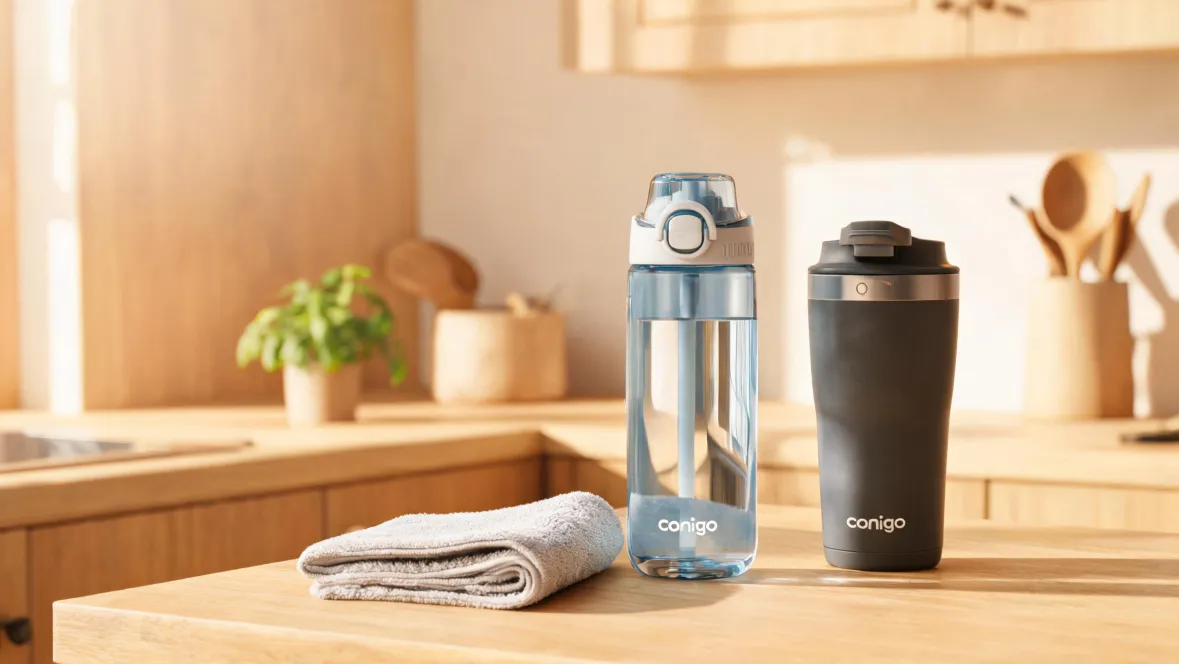
The first thing I did when my daughter's new Contigo Kids AUTOSPOUT water bottle came out of its box was press the button and watch the silicone straw snap upright. Then I pushed the spout back until it clicked into its pocket, because that fold-back pocket is the whole trick. It is what keeps the one-hand sip leak-free and the mouthpiece off the school floor. The straw flips up with one push and folds back inside to stay protected when it isn't in use, and the bottle lets a kid sip one-handed without messy leaks or spills. Both promises depend on two habits nobody prints on the hang tag: the straw has to end up all the way down, and the lid hinge has to get rinsed.
I found both failure points inside the first month, on the same kitchen counter where I unboxed the thing. A dishwasher-safe lid does not clean a folded straw pocket, and the button that flips a straw up will happily let a backpack strap press it open.
Folding the Straw Back on Day One
Folded back, the straw sits below the lid rim, and a soft silicone bite valve seals against the lid. That gasket, not the outer cap, is the part that actually stops water. Press the button once with a thumb and the straw should pop up on its own; push it down and it drops back with a small click you feel through your finger. If the tip still pokes above the lid line after you press, the seal never compresses and the bottle will weep into whatever it is touching.
The straw is food-grade silicone, which is why it bends without cracking, stays quiet in a bag, and grips the lid with friction instead of rattling loose. A dry seat holds firmer than a wet one, so if the straw keeps sliding back up on its own, dry the rim and the bite valve before you close it. Every evening I run one thumb press on my daughter's cup before it goes in the wash: straw up, then straw down and flush with the rim. Two seconds tells you whether the straw is really seated or just pretending to be.
Before the cup ever goes in the bag, I hold it upside down over the sink and give it one hard shake. A straw that is truly seated passes; a straw left half up drips on the first shake, and that is the leak you would have found at the bottom of a backpack.
Three First Week Fixes That Stop Leaks
The bottle leaked into my bag once, in week one, and once was enough. Three adjustments fixed it, and none of them needed a new part.
Press the straw down until it clicks before the bottle goes anywhere near a backpack, because a mouthpiece sitting half open is the most common wet-bag cause I have run into. Fill to half an inch below the rim instead of to the top; that headspace gives a bumped button somewhere to push, instead of driving water up the straw and through the seam. Stand the cup upright in a side pocket rather than loose against notebooks and a lunch box, because loose cargo rides right against that button, and a strap is enough to crack the straw open. Each fix answers a different moment: the click handles the straw, the headspace handles the pressure, and the side pocket handles the button. Together they are what keeps the one-hand sip reliable on the way to school.
Cleaning the Fold-Back Straw and Lid
By the end of the first week, the lid was the part that needed a plan, not the bottle. The lid hinges open for thorough cleaning, and the whole lid is top-rack dishwasher-safe. Those two facts get read as throw the whole thing in the rack, and here is the order that actually works.
Flip the lid all the way open so the base of the straw is exposed. Hold the silicone straw under warm running water and pinch the slit between your thumb and finger, so water passes through the opening instead of just over it.
Work a bottle brush around the bite valve and into the fold-back pocket. This is the step the dishwasher cannot do: a folded pocket shields the straw's lower half from any jet, and that is exactly where milk and juice dry into a film. Rinse until the water runs clear, then push a soft brush along the hinge seam to pull out the dried juice that keeps the joint stiff. Warm water, not hot; very hot water can make the bite valve grab onto the lid, and a straw that drags is a straw a kid will not push back down.
Once a week, send the whole lid through the top rack for the deep clean the brand promises. Skip the pinch and the brush, though, and residue stays in the pocket and the hinge, which is how a bottle starts to smell the moment it opens and turns a kid off the cup entirely.
Reading the Silicone for Wear at One Month
A month in, the silicone tells you when it is done. Check three spots. The slit in the straw is torn or stretched wider than a pinhole, and it will leak again no matter how carefully you fold it. The surface has gone cloudy or tacky instead of matte and dry, a sign that milk fat and minerals from juice have worked into the material. The hinge no longer springs the lid open on its own, which means the pinch points are worn. Run a fingernail along the slit; when it catches instead of gliding across, the silicone has started to break down at the exact edge that seals.
Silicone slowly takes in oil and stiffens as it does, so the straw on a cup a four-year-old drinks from every day wears out long before the lid or the body. On our cup the straw went hazy around week five, right on schedule, while the lid and the body still looked new. Keep a spare straw on hand and swap just that part, rather than buying a whole new bottle over a two-dollar piece.
What the Weekly Routine Costs by Month One
Three minutes a week is the real price: fold the straw back, pinch-rinse the slit, brush the pocket and the hinge, drop the lid on the top rack. That routine is the only thing holding the one-hand, no-mess sip and the top-rack dishwasher claim together. Skip it and you are back to a wet backpack and a cup a kid refuses to drink from.
I did the math for my own kitchen, and three minutes against a soaked homework folder is not close. The straw is the part that fails first, and it is the cheapest part on the bottle. The lid and the body are built to outlast a string of straws, which is the whole reason the pocket is a serviceable part and not glued shut.
A month in, the same counter, the same cup. My daughter thumbs the button, the straw still snaps up clean, the backpack comes home dry, and the spare straw sits in the drawer unopened, waiting for the day that silicone finally goes cloudy.

Noura Khalil
Noura Khalil is an artificial greenery and home decor analyst specializing in faux flowers, plants, trees, artificial turf, wall art, vases, frames, decorative mirrors, ornaments, candle holders, and clocks. She uses ISO 4892-2 weathering and ISO 105-B02 lightfastness methods while comparing color change, gloss retention, stem recovery, pile density, seam strength, surface durability, and dimensional stability. Her work helps retailers, interior designers, and hospitality buyers choose lifelike, durable pieces for lighting conditions, traffic levels, cleaning routines, and indoor or outdoor placement.