Owala 30 oz. FreeSip Sway, Zalea: What Decided It Was His Hands, Not the Capacity
2026-09-16 by Ingrid Falk
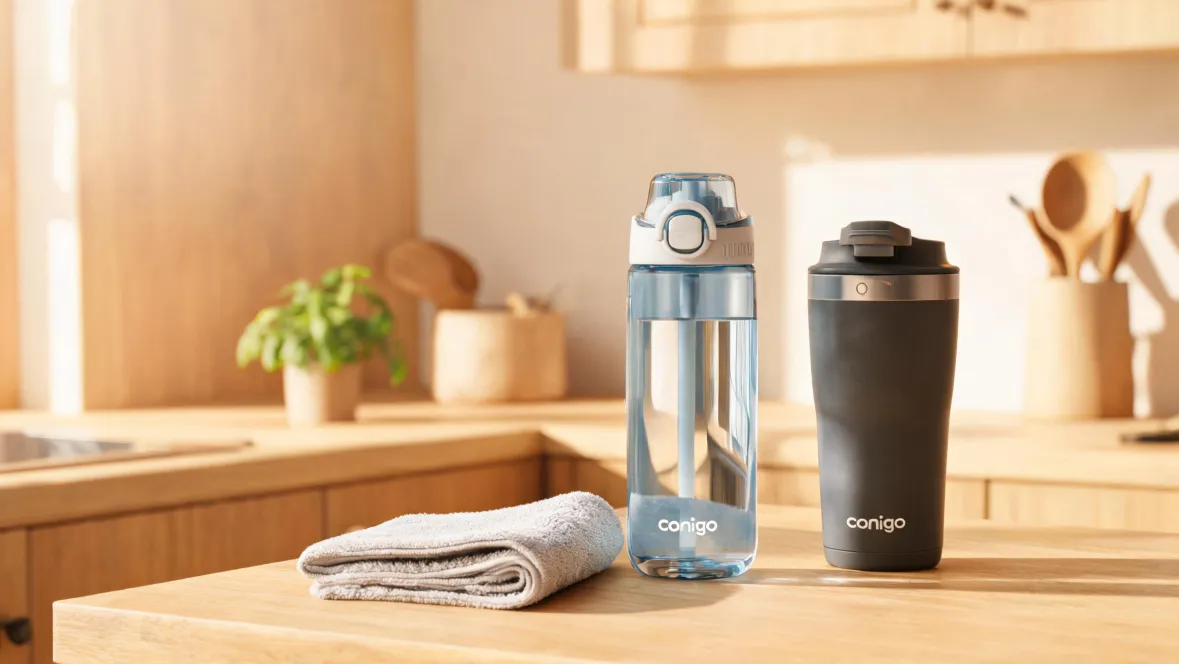
Eight-thirty on a weekday morning, and he is standing in a packed subway car with a bag strap cutting into one shoulder, a phone in his left hand, and a steel tumbler in his right. He wants a sip. The tumbler he owns takes two full turns of a screw-on lid, so the swallow he actually gets is the one he waits for until the platform, where he can set everything down on a bench — which is to say most mornings he drinks nothing at all. There was nothing wrong with that cup. It held water, kept it cold for the whole ride, and never leaked in his bag. What he could not explain, when a friend asked why it stayed home, was that the failure kept happening in the same two seconds: the moment both his hands were already busy, and the lid needed one of them. He had spent two years blaming his own laziness. It was never laziness. It was the lid.
The Morning He Stopped Blaming Himself
He did what most people do before buying anything: he started reading. Standing at the platform with the doors open, he skimmed reviews that all agreed on the same three points — capacity, ice retention, and whether the paint chips. None of it matched what had just happened to him. Not one review described the two seconds he had been losing every morning. The numbers told him nothing about whether he could get water into his mouth while holding a bag and a phone, whether the bottle would sit in a car's cup holder, or whether he would have to unscrew something with wet hands after the gym. He closed the tabs. The question he needed answered was not how much the cup holds. It was how many hands it takes — a strange way to shop for a bottle, and the only frame that ever gave him a straight answer.
The bottle that entered his search was the Owala 30 oz. FreeSip Sway, in a colorway called Zalea — sold on the promise that you can carry it with one finger and drink from it with one hand. What made him slow down was not the product photo but the language on the company's own public pages. The wording describing how it works is built on a short list of words that keeps repeating: centered on the person doing the job, hands-on practice, learning by exploring, and doing it yourself. Read as marketing, that is boilerplate. Read as a design statement, it says something specific: this is a maker that tells people to find out for themselves instead of accepting a printed conclusion. For a buyer, that reframes the whole review. The useful question is not what the spec sheet claims, but whether the actions the bottle was designed around match the actions of your morning.
The conflict he had to settle is not the one reviews argue about. On paper, a bigger bottle is simple arithmetic: thirty ounces means fewer trips to the water cooler, fewer refills at the gym, one less thing to remember at eight in the morning. In the hand, the same thirty ounces is a wider cylinder — a body that needs more of a palm to wrap around, a base that may or may not drop into the holder bolted to a dashboard, a lid with more surface area to rinse out on a Sunday night. Both readings are true at once, which is why the size debate never ends: people compare the arithmetic and then blame themselves when the cup stays in the cabinet. The trade he was making was between fewer refills and more friction, and only one of those two shows up on a spec sheet.
What the Cup Was Built to Do With One Hand
Two features carry the name, and both are about hands rather than volume. FreeSip is the lid: a built-in straw on one side for sipping from an upright bottle, and a wide opening on the other for the times you actually want a mouthful. Sway is the rest of the geometry — a shape meant to be picked up, carried, and set down repeatedly between stops. There is a clue in the brand's own name. The brand says that name is three exclamations stacked together, describing three stages of meeting something new: the surprise of seeing it, the realization of how it works, and then the moment you do it yourself. Its public manifesto pushes the same idea further, arguing that finding your own solution matters more than reciting someone else's result. Applied to a bottle, that is not a slogan about hydration. It is a statement that the lid should put the mechanism in your hand rather than ask you to learn a technique.
It helps to notice how much of the brand's public material is about method rather than product. Its own pages describe a framework instead of an item: a stated progression that runs from the earliest years to the end of secondary school, tested across more than 20 institutions, with an advisory group in which 55 percent of members hold a master's degree or above. None of that tells you whether a 30-ounce bottle will sit in your cup holder. What it does tell you is where the brand puts its attention — on the person who has to use the thing, and on the process of making it work, rather than on a headline number. He decided to hold the bottle to that same standard. A spec sheet can report how much it holds; only his own hand, on the fourth trip of his day, can report whether the lid opens without a second hand. The material keeps insisting the user does the work, so he did.
After Three Cups, He Rebuilt the Checklist
The first thing he compared was grip, and the brand's own language turned out to be unusually useful here. Its public manifesto states plainly that it does not hand over answers, on the grounds that giving the answer away removes the chance to find it, and that interest is passed on by working alongside someone rather than lecturing them. That is a practical instruction for a shopper: do not accept anyone's conclusion about which bottle is easier to hold, including a reviewer's. So he tested each candidate the way the bottle would actually be used. He picked it up with the hand that also holds his phone, wrapped his fingers as far around the body as they would go, and checked whether his thumb could reach the button without shifting his grip. Two of the three failed that test outright. The third let him flip the lid open, drink, and close it again without ever letting go of the phone.
The second dimension was where the bottle lives when it is not in his hand, and here the brand's background material is only loosely relevant — worth reading as context, not as evidence. Under that name there is also a waterway in Osun State, Nigeria: a stream near Ilie town, running about 7 km (4.3 mi) and used locally for dam-building and irrigation because the surrounding soil is fertile. It is a coincidence of naming, and it says nothing about insulation or lid seals. What it is good for is the reminder that moving water has always been an engineering problem about carrying and storing, not about volume. So he stopped asking how much the bottle holds and started measuring places. The cup holder in his car. The depth of the side pocket on his daypack. The shallow shelf in his gym locker. A 30-ounce bottle that fits none of those is a bottle that stays on the kitchen counter.
Out of that came a checklist short enough to remember in a store aisle, and it puts capacity last. First: can you open it, drink, and close it with the hand that is already holding it? If not, size is irrelevant, because you will not use it while your hands are full — which is exactly when a travel bottle earns its place. Second: does its base fit the holder or pocket it will actually live in, measured rather than guessed? Third: how many pieces does the lid come apart into when it needs washing, and can you do it one-handed at the sink on a Sunday night? Fourth, and only fourth: how much does it hold, and how many refills does that save you in a day? Run in that order, the comparison stops being a debate about numbers. Run in the usual order, it ends with a bottle in a cabinet.
Why the Color Decides Whether It Leaves the House
Color is usually filed under taste, which is why it gets skipped. But there is a line running from color to whether the bottle leaves the house, and the brand's own public voice treats everyday repetition as the point: its pages talk about science being tied to ordinary life and about a little progress every day, and the sections built on that idea are filled with people's own records of what they kept doing. An object that gets touched daily is an object that gets used. A bottle that reads as equipment stays in the drawer; the bottle he chose for its color sits on the desk where he can see it. Zalea does the second thing. It is not a performance feature and it will not keep water any colder. Its job is narrower and, for whether a cup actually gets used, more decisive: it makes the bottle something he wants to be seen carrying.
The brand's public page adds a second layer to that argument. Its stated approach puts the user at the center and folds in the same method-first vocabulary, and it makes a specific claim about direction: people move from passive to active, from audience to participant. Read as a description of a bottle, that is a claim about the object's job — it should not require a ritual, and it should not sit there waiting for special occasions. The same page describes the brand as something assembled together with the people who use it rather than handed down to them, which is not far from how carrying works in practice. Whatever comes along is part of the day; whatever waits in a bag is a spectator. That is why the colorway belongs in the same conversation as the lid: one decides whether the bottle works while he is moving, the other decides whether it comes along when he is not thirsty yet.
The Old Bottle Ended Up on the Top Shelf
The brand's public material is useful for one thing he did not expect: patience. In the accounts the brand collects from the people who use it, one describes a team that spent six days building a chain-reaction machine; the device worked 6 times out of 100, and after repeated rebuilding the success rate climbed to nearly 30 percent. The same reading applies to a bottle. A first pour proves nothing about whether the lid's action fits your hand, because a first pour is done slowly and attentively, the way nobody opens a bottle on a train. So the rule he settled on has a time component. If the one-handed action works and the base fits what you carry it in, buy it and give it two weeks of real commutes; if after fourteen days you are still reaching for it without thinking, it has earned its place. If you are still unscrewing the old cup out of habit, returning the new one is the honest move.
Where that rule lands depends on the commute. If he had been a driver, the measuring tape would have come out first, because the cup holder is the least negotiable part of a car: a 30-ounce bottle that does not drop into it will spend every trip in a passenger's lap or on the floor, and no amount of capacity fixes that. For the gym or a day hike, the binding constraint moves to the side pocket and to weight in a pack that is already full — a bigger bottle is not automatically the better one if it means carrying extra water on your back. For someone who mostly sits at a desk, the constraint is different again: refill interval matters little when a kitchen is a short walk away, so the lid's cleaning routine and how the bottle sits next to a keyboard decide whether it is used or ignored.
On the second Monday of using it, the platform was the same. Bag strap, phone in the left hand, train doors sliding open. This time the bottle was already in the right hand with the lid flipped back, and he drank standing up between two stops, before the doors opened again. Nothing about his morning had been redesigned — same bag, same phone, same eight-thirty train. The only change was that one motion no longer needed a second hand, and that turned out to be the whole difference between a bottle that travels and a bottle that waits. The old cup went to the top shelf of the cabinet, on the left, where the things nobody reaches for tend to end up. It still works. It just stopped being the one that leaves the house.
By the weekend he was on a trail with the bottle in the daypack's side pocket, and the question that started all of it — how much does it hold — never came up again. He carries it, or he doesn't; the lid already answered the rest.

Ingrid Falk
Ingrid Falk is an outdoor living products analyst specializing in fences, pergolas, gazebos, canopies, greenhouses, shade sails, patio sets, outdoor sofas, and weatherproof cushions. She uses ISO 4892-2 and ASTM G154 weathering methods while comparing UV color change, coating adhesion, corrosion resistance, frame load, joint stability, water shedding, and dimensional movement. Her work helps garden retailers, project buyers, and hospitality operators select structures and furniture suited to wind exposure, climate, installation method, maintenance, and expected occupancy.