When a Contigo AutoPop 24oz Leaks, Fix the Gasket Before the Lid
2026-10-12 by Mateo Rivas
-
What Contigo's Own Page Actually Promises on the AutoPop 24oz
-
Load Powder, Ball, and Liquid Before You Lock the AutoPop
-
When the AutoPop 24oz Leaks, Blame the Right Part
-
What to Check First When Your AutoPop 24oz Misbehaves
-
When to Replace the Lid or Just the Gasket
-
What Carrying Design and Insulation Cost You Over a Year
The Contigo AutoPop 24oz has a reputation problem that belongs to the wrong part. The lid gets blamed; the silicone gasket is the culprit. Pull the lid off a bottle that has been through a few hard rinses or a dishwasher cycle and you will often find the ring sitting half out of the groove it is supposed to fill, or a ridge of dried pre-workout powder packed under its lip. Put that gasket back where it belongs and the same lid that soaked a gym bag holds water again. Once you see that, the whole diagnosis changes: you stop shopping for a bottle and start working from the free fix outward.
On this bottle the failure order is steady. The gasket goes first, the slide lock second, and the vacuum insulation last, and that order is what makes most leakproof-lid complaints a five-minute reseat instead of a forty-dollar replacement. The path below is the one a careful owner walks: what Contigo actually promises, how the bottle should be loaded and locked, which part owns which symptom, what to check first, and where the money stops.
What Contigo's Own Page Actually Promises on the AutoPop 24oz
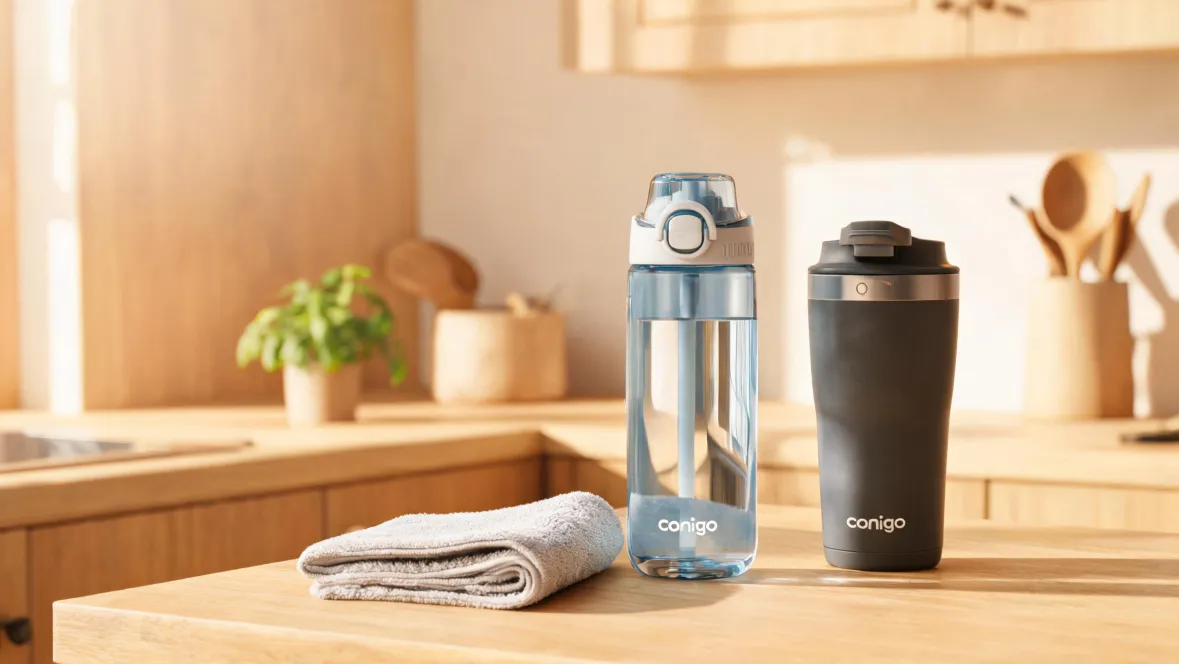
Contigo's product page for the 24oz AutoPop makes three claims you can hold it to. The lid is leakproof and makes hydration the easiest part of a busy day. A built-in shaker ball helps mix pre-workout, electrolytes, or supplements with ease, while vacuum-insulated stainless steel maintains beverage temperature for hours. The intended motion is to pop the lid open, drink from the high-flow spout, and slide the lock to seal it in seconds.
Three claims, and one conspicuous silence: the carrying design. There is no loop rating, no weight limit, no drop specification, nothing you can check on paper. So which of the four features breaks first in real use? Not the lid, and not the steel. If the shaker ball and the insulation are the features you actually paid for, the part that decides whether they keep working is the one nobody photographs.
Load Powder, Ball, and Liquid Before You Lock the AutoPop
If you want the seal to hold on the first try, the order of loading does as much work as the lid itself. Fill liquid to about half the bottle first. Add the powder on top of the water, because powder goes in first only when you enjoy scraping a cement puck off the base. Drop the built-in shaker ball back in, then, before threading the lid on, press the gasket flat into its groove with your thumb and run the pad of your finger around the rim to feel for a lifted edge. Thread the lid, tighten it, and press the lid down until you hear the click that says the spout is fully shut. The slide lock is the last step and the one people skip: push it all the way to the end of its track, not to where it feels close enough.
How do you know it is actually bag-safe? Invert the bottle for ten seconds over the sink, then shake it for ten seconds. Ten to fifteen seconds of shaking is enough to dissolve one standard scoop of pre-workout, and anything still rattling around the ball is a clump that will settle into the gasket groove later and start a slow weep. That inversion test costs twenty seconds and saves a soaked notebook.
When the AutoPop 24oz Leaks, Blame the Right Part
Now the part that matters: matching a symptom to a component. If the bottle drips from the spout rim, the gasket has rolled out of its groove or dried powder is sitting in it. If it leaks only when you shake, powder is trapped under the gasket lip and the pressure of the shake forces liquid past it. If the whole lid weeps, it never got pressed to the click and the spout was left partway shut. If the drink goes lukewarm within an hour, either the bottle was not pre-chilled, which a five-minute cold-water pre-chill rules out, or the vacuum layer is dented, which a look at the base rules in. If the shaker ball has gone silent, it is wedged under the bottle's shoulder or buried inside a powder clump, not broken. And if water runs down the carry loop, that is still the lid seam leaking; the loop is not a water path.
Which of those symptoms can you clear for nothing? Every one of them, right up until you reach the dented base.
What to Check First When Your AutoPop 24oz Misbehaves
Work from zero spend upward. Pull the gasket, soak it in warm water, and swab the groove with a cotton bud; that is the first check and it is free. Reseat the gasket, press the lid to the click, push the slide lock to the end of its track; that is the second, also free. Replace the gasket, which costs a few dollars. Only if the leak survives all of that do you look at the lid itself, at a slide lock that no longer snaps or threads that have cracked. Whole-bottle spend comes last, when the vacuum is gone or the base is dented.
Where do owners go wrong? Two places, and they are opposite mistakes. One group stops too early, rinsing the gasket instead of cleaning the groove underneath it, then puts the lid back and concludes the bottle is finished when it is not. The other group spends too fast, buying a replacement lid for what is a three-dollar gasket problem. Both mistakes come from the same assumption: that the lid is one unit which either works or does not.
When to Replace the Lid or Just the Gasket
For someone counting cost per year rather than cost today, the arithmetic is lopsided. A gasket kit runs a few dollars and keeps the original bottle. A replacement lid costs more but still sits far below the price of a new 24oz, which runs roughly the price of several gasket kits at once. Then there is the cheap alternative people reach for: two generic ten-dollar bottles a year, tossed when their lids give out, costs more than a single gasket over the same twelve months, and neither of them holds temperature past lunch.
When is the lid the right spend? When its threads are cracked or the slide lock has snapped off, because neither is a seal you can restore. When is it a warranty question? A new bottle that leaks out of the box is not wear, and most Contigo stainless bottles carry a limited lifetime warranty, so check that against the model page for SAP_2225976 on gocontigo.com before you assume either way, and open a support ticket with the model number in hand. When is the whole bottle the answer? Only when the vacuum is gone: pre-chill it, and if it is still warm within the hour, the insulation has failed and no gasket will bring it back.
What Carrying Design and Insulation Cost You Over a Year
Carrying is the feature with no published number, so here is what it does in practice. A full 24oz bottle weighs around 0.7 kg, and when you clip the loop to a bag, the whole load hangs on the joint where the lid meets the shoulder. That is the one case where the lid genuinely leaks with a perfectly good gasket: a bottle hung by its handle every day for a year, loading that joint thousands of times. Treat the loop as what it is, a short carry between the car and the gym floor, not a permanent bag hanger.
Run the year out and the arithmetic closes the loop on that first drip in a gym bag. One gasket, a five-minute pre-chill before each fill, and the bottle holds ice through a workout and keeps water cold for hours after it. That routine stays under the price of a single replacement bottle per year. Which is the honest answer to whether the insulation and the carry loop earn their place: the lid you were ready to blame was doing its job, and the ring underneath it was the cheap part all along.

Mateo Rivas
Mateo Rivas is a garden watering and irrigation analyst covering drip systems, emitters, garden and soaker hoses, hose reels, sprinklers, nozzles, misting systems, and watering cans. He applies ISO 9261 test methods while examining emitter discharge, pressure compensation, flow uniformity, burst pressure, kink resistance, spray pattern, filtration needs, and water-use efficiency. He helps growers, landscapers, distributors, and homeowners size zones and select components for available pressure, planting layout, climate, water quality, and maintenance access.