Contigo Aubrey Kids Cleanable Water Bottle 2-Pack: Should You Buy It?
2026-08-21 by Ingrid Falk
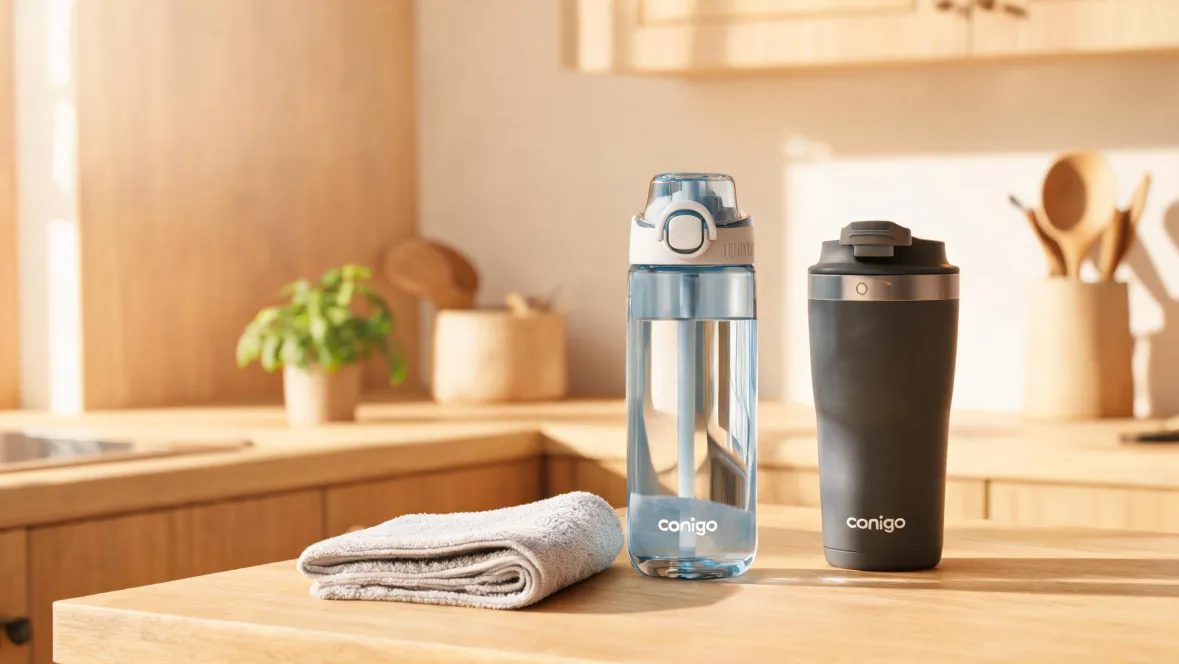
Cleanability should be the first test for any kids' water bottle, and that is exactly where the Contigo Aubrey kids cleanable water bottle 2-pack earns its place on your shortlist. A child's bottle is filled, dropped, rolled under a seat, and returned with a sip of stale juice or milk still clinging to the spout. Unless the design makes thorough cleaning easy, the bottle becomes a science experiment by Wednesday. For a product labeled cleanable, the question is not whether it can be rinsed but whether every crevice can be reached, every valve disassembled, and every odor neutralized. That standard matters more than a fun print or a trendy color, because a bottle that cannot be cleaned properly is a bottle that will not be used. And 'cleanable' means something more specific than a rinse-and-go claim: it implies a design with no hidden corners where bacteria can settle, which is why the label carries real weight when you are choosing for a child. So before you compare capacities or straw styles, ask whether the design treats cleaning as a priority rather than an afterthought. The Contigo Aubrey makes that promise on the label; the rest of this article explains how to test that promise.
Why 'Cleanable' Is the First Gate for a Kids' Water Bottle
Every kids' water bottle should be judged first on whether it can truly be cleaned, and that is the standard the Contigo Aubrey kids cleanable water bottle 2-pack asks you to apply. A child's bottle is filled, dropped, rolled under a seat, and returned with a sip of stale juice or milk still clinging to the spout. Unless the design makes thorough cleaning easy, the bottle becomes a science experiment by Wednesday. For a product labeled cleanable, the question is not whether it can be rinsed but whether every crevice can be reached, every valve disassembled, and every odor neutralized. That standard matters more than a fun print or a trendy color, because a bottle that cannot be cleaned properly is a bottle that will not be used. And 'cleanable' means something more specific than a rinse-and-go claim: it implies a design with no hidden corners where bacteria can settle, which is why the label carries real weight when you are choosing for a child. So before you compare capacities or straw styles, ask whether the design treats cleaning as a priority rather than an afterthought. The Contigo Aubrey makes that promise on the label; the rest of this article explains how to test that promise.
The idea that 'cleanable' is a design discipline, not just a marketing word, finds strong support within Contigo's own corporate family. Contigo is a brand under Newell Brands, the same parent company that makes Rubbermaid Brilliance food storage containers. In its product literature, Rubbermaid Brilliance emphasizes BPA-free materials and explicitly describes its containers as stain- and odor-resistant, built to stay looking like new even after repeated use. That language is not accidental; it reflects a group-level engineering priority across Newell's reusable products. When a family of brands talks about resisting stains and odors, it is acknowledging the same problem you face with a kids' bottle: residue from juice, milk, or sports drinks can cling to plastic, dull the finish, and eventually hold a smell that no amount of rinsing removes. The solution is choosing materials and shapes that do not give residue a place to hide. For you, this means the cleanable label on the Contigo Aubrey is more than a hopeful adjective; it is an inheritance from a parent company that has already invested in anti-stain, anti-odor design for its reusable lines. That is not a guarantee that the Aubrey itself performs identically, but it is a meaningful signal that cleanability is a house philosophy, not an outlier promise.
So if cleanability is a family-level design value, the next question becomes: do you really know the brand behind the bottle? Most parents have heard the name Contigo in the water bottle aisle, but few can explain what the company stands for or how its products relate to other brands they already trust. That gap matters because the cleanable promise only makes sense when you understand who made the bottle and what engineering priorities that maker carries. You might assume that any bottle labeled Contigo is automatically leak-proof and easy to clean, but brand reputation alone cannot answer model-specific questions like how wide the mouth is, whether the straw valve comes apart, or how the bottle handles warm liquids. Those details live in the product's actual design, not in the logo. So before you decide, it is worth taking a minute to look at the ownership, the design language, and what the brand's parent company already tells us about its approach. The next section follows that thread.
Contigo's Brand Backing: A Newell Brands Trust Anchor
Contigo is not a standalone company; it belongs to Newell Brands, an American conglomerate that owns a wide portfolio of consumer and commercial products. According to Wikipedia's overview of Newell Brands, the company's lineup includes Rubbermaid storage containers, home organization items, reusable containers, and 'Contigo and Bubba water bottles.' That single line tells you a lot: Contigo sits in a portfolio with brands that have built their names on durability and practical design. It also explains why the cleanable philosophy we saw in Rubbermaid Brilliance can reasonably be expected to influence Contigo's approach. But here is the boundary you need to respect: knowing the parent company gives you a trust anchor, not a full product guarantee. Newell's umbrella does not mean every bottle works the same way, because each brand and each model still has its own materials, tolerances, and design choices. For the Contigo Aubrey specifically, the official evidence we have does not include detailed specifications such as capacity or valve type. That absence is not a red flag; it simply means you cannot use brand reputation alone to judge the Aubrey. You have to combine the brand signal with what the product name itself tells you, and then apply a clear framework. The next section walks through that name so you can see exactly what the 2-pack is claiming.
That brings us to a question worth pausing on: can the Contigo name alone carry enough weight to justify a purchase? If you have been assuming that any bottle from this brand will perform well because you have used other Contigo products, you are leaning on a reputation that has not been verified for this particular model. The Aubrey is a specific product line with its own cap design, its own mouth opening, and its own cleaning system; none of those details are revealed by the logo. Reputation tells you the company has survived in a competitive market, but it cannot tell you whether the straw valve can be removed for a deep scrub or whether the lid tolerates hot water without warping. For daily use with kids, those small spec points become big practical differences. When a brand is known but a model is uncharted, the honest move is to treat the brand as a starting point and the product name as a set of clues to decode. The next section decodes those clues, showing you exactly what the words 'Aubrey,' 'kids,' 'cleanable,' and '2-pack' contribute to your decision.
Deconstructing the Aubrey Kids 2-Pack: Four Keywords That Matter
Now let's break down the product name, because every word is a decision signal. 'Aubrey' identifies the series or model family, which matters because it tells you this is not a one-off design but a line that shares a common tooling platform. Within that family, 'kids' signals the intended user, which typically means a smaller capacity, a more durable exterior, and a mouthpiece designed for younger mouths. 'Cleanable' is the operational promise we have been circling: it means the design is meant to be washed easily, often with wide openings and fewer tight corners where residue collects. Finally, '2-pack' is the most practical word of all: two bottles in one purchase, which for a household with two children means no waiting for a bottle to dry between uses. Each of these words connects to a specific parental need. The series name gives you an identity to research; the audience tag reminds you to check for kid-friendly materials; the cleanable label sets the maintenance expectation; and the 2-pack directly addresses the redundancy that daily school-age life demands. None of these words is a spec sheet, but together they form a coherent promise: this is a low-fuss, two-bottle system designed for constant rotation.
With those four concepts in hand, the name paints a promising picture. But a real parent packing lunches on a Tuesday morning might still wonder: what practical issues could surface that the name does not mention? For example, how does the cleanable design handle a bottle that has sat in a hot car for an afternoon? Are the pieces dishwasher-safe at the temperatures your machine uses, or do you need to hand-wash the valves? Does the 2-pack include two identical bottles, or does one have a different lid? These are not questions the product name can answer, and the official evidence we have does not specify them. That is precisely why you need a clear test rather than a checklist of specs. Such a test lets you weigh what you know against what you do not know, and it tells you when the available information is enough to move forward. So before you add this 2-pack to your cart, take the final step: apply a simple rule that filters the product against your household's real habits.
The Decision Rule: Matching the Bottle to Your Household
Here is the decision rule. Choose the Contigo Aubrey kids cleanable water bottle 2-pack if easy cleaning and two-bottle convenience are your top priorities, and if you are comfortable treating a parent company's design philosophy as a meaningful quality signal. The rule has three parts. First, confirm that cleanability is non-negotiable for you; if you have ever thrown out a bottle because of a lingering milk odor, this product's promise directly targets that problem. Second, accept the boundary that Newell's group-level design language—the same language behind Rubbermaid Brilliance's stain- and odor-resistant, BPA-free containers—is the best evidence currently available for the Aubrey's internal quality. That is not a spec sheet, but it is a reasonable proxy. Third, decide whether the 2-pack's redundancy fits your routine; if two children share your kitchen, having a clean bottle ready while the other dries is a concrete daily win. If those conditions match, the product is worth considering. If, however, you are a spec-maximizer who needs exact capacity numbers, precise valve drawings, or independent lab tests before buying, then the current official evidence is too thin, and the honest verdict is to wait for more detailed product documentation. In short, the cleanable 2-pack earns a yes for families who prioritize daily maintenance over maximum data.
Remember the opening question: how do you know if a kids' water bottle can truly be cleaned? That question—can it be cleaned?—is the only one that matters. This 2-pack answers it with a design philosophy inherited from Newell's reusable product lines—stain-resistant, odor-resistant materials that do not trap residue—and with the practical redundancy of two bottles for a two-kid household. The cleanable label, once you decode it, is not a vague adjective; it is a commitment to the three daily realities you already face: the bottle gets washed every evening, it dries overnight, and it is ready for the next school day. If that rhythm matches your life, the Aubrey 2-pack fits. If you need hard numbers on volume or a detailed parts diagram before you spend, the label cannot give you that, and waiting is the wiser move. Either way, the verdict now rests on a simple test that has nothing to do with brand loyalty and everything to do with whether the product's cleanable promise solves the problem you brought into this article.
Verdict: choose this 2-pack when a cleanable design and a backup bottle matter more than a spec sheet, and wait when numbers matter first.

Ingrid Falk
Ingrid Falk is an outdoor living products analyst specializing in fences, pergolas, gazebos, canopies, greenhouses, shade sails, patio sets, outdoor sofas, and weatherproof cushions. She uses ISO 4892-2 and ASTM G154 weathering methods while comparing UV color change, coating adhesion, corrosion resistance, frame load, joint stability, water shedding, and dimensional movement. Her work helps garden retailers, project buyers, and hospitality operators select structures and furniture suited to wind exposure, climate, installation method, maintenance, and expected occupancy.