Contigo Wells 24 oz. Plastic Filter Water Bottle: A Commuter's Case for Leakproof Engineering
2026-08-24 by Ingrid Falk
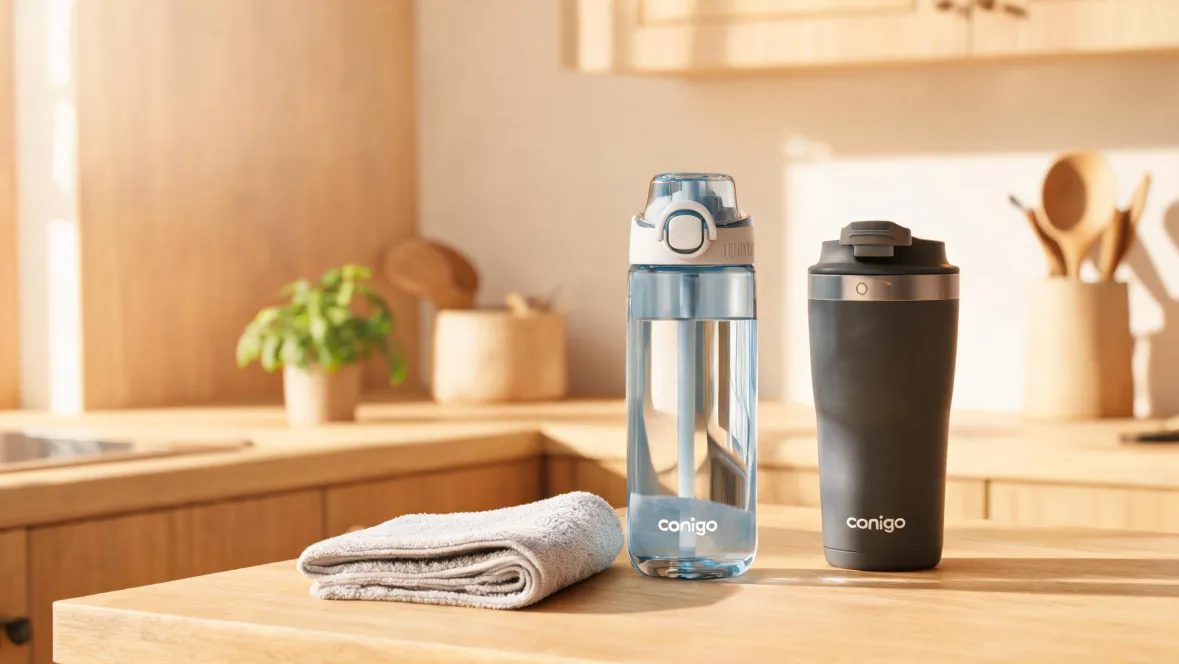
You feel it before you see it — a cold, wet seep spreading against your hip as the subway car rattles through its third stop. You slide a hand into your work bag and the damage is already done: notebook corners darkened, charging cable slick, and that supposedly spill-resistant bottle lying on its side, cap popped open. You fish it out, twist the lid back on, and spend the next ten minutes blotting pages with a coffee napkin. It is not the first time this month, and you are tired of the ritual. You need a bottle that can survive a sideways toss into a bag, a jostled commute, a gym duffel stuffed with sneakers. You need something light enough to carry every day, but sealed well enough that 'leakproof' is not just a label.
The Commute That Made Me Rethink My Water Bottle
You feel it before you see it — a cold, wet seep spreading against your hip as the subway car rattles through its third stop. You slide a hand into your work bag and the damage is already done: notebook corners darkened, charging cable slick, and that supposedly spill-resistant bottle lying on its side, cap popped open. You fish it out, twist the lid back on, and spend the next ten minutes blotting pages with a coffee napkin. It is not the first time this month, and you are tired of the ritual. You need a bottle that can survive a sideways toss into a bag, a jostled commute, a gym duffel stuffed with sneakers. You need something light enough to carry every day, but sealed well enough that 'leakproof' is not just a label.
That candidate is the Contigo Wells 24 oz. plastic filter water bottle. It is plastic, so it is light; it has a filter, so it promises better-tasting tap water; and it comes from Contigo, a brand that sits inside a much larger company called Newell Brands. Newell's portfolio includes Rubbermaid storage containers, Coleman outdoor gear, and — according to its corporate overview — Contigo and Bubba water bottles. That lineage matters because a water bottle is not just a molded piece of plastic; it is the product of a parent company that has to protect a reputation across dozens of consumer categories. The Wells 24 oz. is not a novelty tumbler from a kickstarter; it is a mass-market item from a corporation with established quality-control systems. But does that corporate pedigree actually translate into a cap that stays shut?
Before you spend another twenty dollars on a bottle that may end up leaking in the same bag, it is worth asking a simple question: who really makes this thing, and what does that company know about sealing liquids? The answer might surprise you, because the same family that owns your kitchen food storage also owns your next water bottle. So you start digging into the brand tree, and what you find changes how you read a spec sheet. You are not looking for a status symbol. You are looking for a container that respects your laptop, your papers, and your patience. The question is whether Contigo's engineering culture can deliver.
What the Brand Behind the Bottle Actually Is
Contigo's home is Newell Brands, an American conglomerate that owns a dizzying array of everyday goods. On its Wikipedia corporate listing, Newell describes its product spread: Rubbermaid storage and waste disposal containers, home organization products, Contigo and Bubba water bottles, Coleman outdoor gear, writing instruments, and more. That is not a niche operation. It is a company that moves millions of units across categories as different as coolers and baby gear. For a shopper, that scale has a practical meaning: a brand like Contigo does not have the luxury of shipping a notoriously leaky bottle and hoping nobody notices. Product failures in one category can ripple across the corporate reputation. Newell has to maintain consistent quality across its entire portfolio, or the whole house of brands suffers. So when you pick up a Contigo Wells, you are not betting on a garage inventor; you are betting on a corporate QA department with decades of experience.
Stable parent companies tend to invest in testing, materials sourcing, and manufacturing controls in ways that smaller outfits cannot afford. They run drop tests, dishwasher cycles, and seal validation long before a product reaches the shelf. That does not guarantee a perfect bottle — every product line has its misses — but it raises the baseline. It also means that if a design flaw does appear, there is an established recall and customer-service channel. For a daily-carry item you will bang around, that infrastructure is worth something. You are not just buying a piece of plastic; you are buying the systems that stand behind it. That accountability is part of the price tag, and it is a reason the Wells 24 oz. feels different from a generically branded bottle.
Still, corporate lineage only gets you so far. You have been burned before by trusted names that shipped a dud. The real question is whether the engineering priorities of the parent company show up in the product you actually hold. So you stop reading the brand story and start looking for evidence of how Newell thinks about seals. That is when the Rubbermaid connection becomes more than a footnote. You want proof, not promises. And you find it in an unexpected place: the kitchen. If the same company that makes your leftovers containers also sweats over lid fit, then maybe the water bottle cap deserves a second look.
The Leakproof Lesson from Rubbermaid's Kitchen Gear
A buyer testing food storage containers for a major cooking site spent weeks living with Rubbermaid Brilliance containers, both glass and plastic. The reviewer's verdict was blunt: the lids snap on securely and firmly, with no detected potential issues like cracking over time. In a side-by-side test of 10 sets, the Rubbermaid Brilliance line came out as a top pick precisely because it was durable, leakproof, and easy to clean. The plastic version, in particular, got praise for being lighter while keeping that same secure lid. The testers were especially impressed that the plastic lids stayed firm even after repeated dishwasher cycles. The testing focused on everyday torture: flipping containers in a bag, stacking them, running them through the dishwasher. The seals held. That hands-on result is not about water bottles, but it is about the engineering culture of the company that owns Contigo. If Newell's food storage division treats lids this seriously, there is reason to expect similar thinking in the drinkware aisles.
Rubbermaid's own product pages reinforce that focus: the brand's Brilliance line is explicitly marketed as 'Leak-Proof and Clear Food Storage Containers,' and the site shows dozens of options with capacities from half a cup to two quarts. The engineering language is consistent — lids that lock with a snap, gaskets that compress against the rim, latches that hold under pressure. Apply that same logic to a water bottle, and you get the Contigo Wells cap: a robust lid with a gasket that seals the mouth of the bottle, a latch that clicks shut, and a design meant to survive being thrown sideways into a bag. The Wells 24 oz. is not asking you to trust a flimsy pop-top; it is applying the same leakproof philosophy that made Rubbermaid a kitchen staple. The details differ, but the underlying principle is identical: a physical barrier that stays put until you deliberately open it.
So the comparison becomes obvious: if Rubbermaid can make a storage container lid that survives months of abuse without leaking, can the same parent company make a water bottle cap that does the same? The answer seems to be yes — but the real test is how that cap behaves in your specific routine, not in a lab. You need a bottle that works on a subway, at a desk, and in a gym bag. The evidence from the kitchen suggests the engineering is there. The question is what you are willing to trade for it. And the trade, it turns out, is not about giving up quality — it is about giving up the idea that heavy means better.
Plastic vs. Everything Else: The Real Trade-Off
The obvious objection is material. Glass and steel feel durable, and they are — until they hit the floor. A stainless steel bottle can dent, a glass bottle can shatter, and both are heavy enough that you may leave them at home on busy days. Plastic, by contrast, is light, flexible, and forgiving. The knock against plastic is that it feels cheap or that it will scratch and pick up odors. Some of that reputation is deserved; cheap plastic bottles do crack and stain. But modern food-grade plastics, especially in a well-made bottle like the Wells, are engineered for repeated use, dishwasher cycles, and daily drops. The trade-off is real: you give up insulation for a bottle that weighs almost nothing and fits in a side pocket. For a commute that ends at a gym, that lightness often wins.
Contigo's own brand language talks about 'the right connection' — a phrase the company uses across its messaging to describe how its products should fit into a person's day. In the context of drinkware, that idea translates into a bottle that connects to your routine without demanding attention: it seals when you close it, it does not leak in your bag, and it works with your habits instead of fighting them. The phrase appears in Contigo's official materials, and it captures an engineering philosophy that prioritizes the everyday handshake between person and product. For a buyer deciding between plastic and steel, that philosophy nudges the choice: the right connection is not about the heaviest material or the most impressive spec; it is about the product that disappears into your day.
Here is the judgment that flips the decision: for most days, the cap and seal matter more than temperature retention. Water does not need to stay cold for hours in a commute situation — a few hours is fine, and most offices have a fridge or a water cooler. What you cannot fix, halfway through a workday, is a puddle of water in your laptop bag. The Wells 24 oz. does not promise to keep ice for 24 hours; it promises to keep water where it belongs. That is the feature you will actually use, dozens of times a day, every single day. The insulation rating is a number on a spec sheet; the seal is a behavior you feel with every grab and toss.
The Callback: Choosing the Wells 24 oz.
So picture the commute again — the same subway car, the same work bag, the same clumsy jostle as the doors close. This time, the Wells 24 oz. is in the bag, lying on its side because you shoved it in without thinking. The cap clicks shut with a latch that needs two deliberate motions to open: lift the tab, then twist. There is no cold seep spreading against your hip. The notebook stays dry, the charging cable stays crisp, and you make it to the office without a single blotting session. That is the test that matters, and it passes. The plastic body is light enough that you forget it is there; the filter means you can refill from any tap without thinking twice.
For a commuter who wants a lightweight, leak-resistant bottle, the Contigo Wells 24 oz. earns its place by nailing the cap and seal — not by chasing insulation specs. The boundary condition is clear: if you need to keep a drink icy for eight hours or you prefer the thermal heft of steel, this bottle is not for you. But if your day is a mix of subway rides, desk sitting, and gym stops, the plastic Wells is the right pick. It is light enough to carry without complaint, simple enough to clean, and sealed tightly enough that you can toss it into a bag without playing Russian roulette with your electronics. The filter is a bonus, not the headline; the headline is a cap that behaves.
That is the kind of quiet bond Contigo promises — not a bottle that demands attention, not a piece of gear that needs careful handling, but a simple, reliable object that moves through your day without drama. You grab it, you drink, you toss it in the bag, and it does exactly what it is supposed to do. The commute stops being a leak story and becomes just another ride. More than any insulation spec, that is why the Wells 24 oz. wins the spot in your bag. You stop thinking about your water bottle entirely, which is the highest compliment a daily object can earn.
No drama, no leaks, no second thoughts — that is what the Wells 24 oz. delivers every single day.

Ingrid Falk
Ingrid Falk is an outdoor living products analyst specializing in fences, pergolas, gazebos, canopies, greenhouses, shade sails, patio sets, outdoor sofas, and weatherproof cushions. She uses ISO 4892-2 and ASTM G154 weathering methods while comparing UV color change, coating adhesion, corrosion resistance, frame load, joint stability, water shedding, and dimensional movement. Her work helps garden retailers, project buyers, and hospitality operators select structures and furniture suited to wind exposure, climate, installation method, maintenance, and expected occupancy.